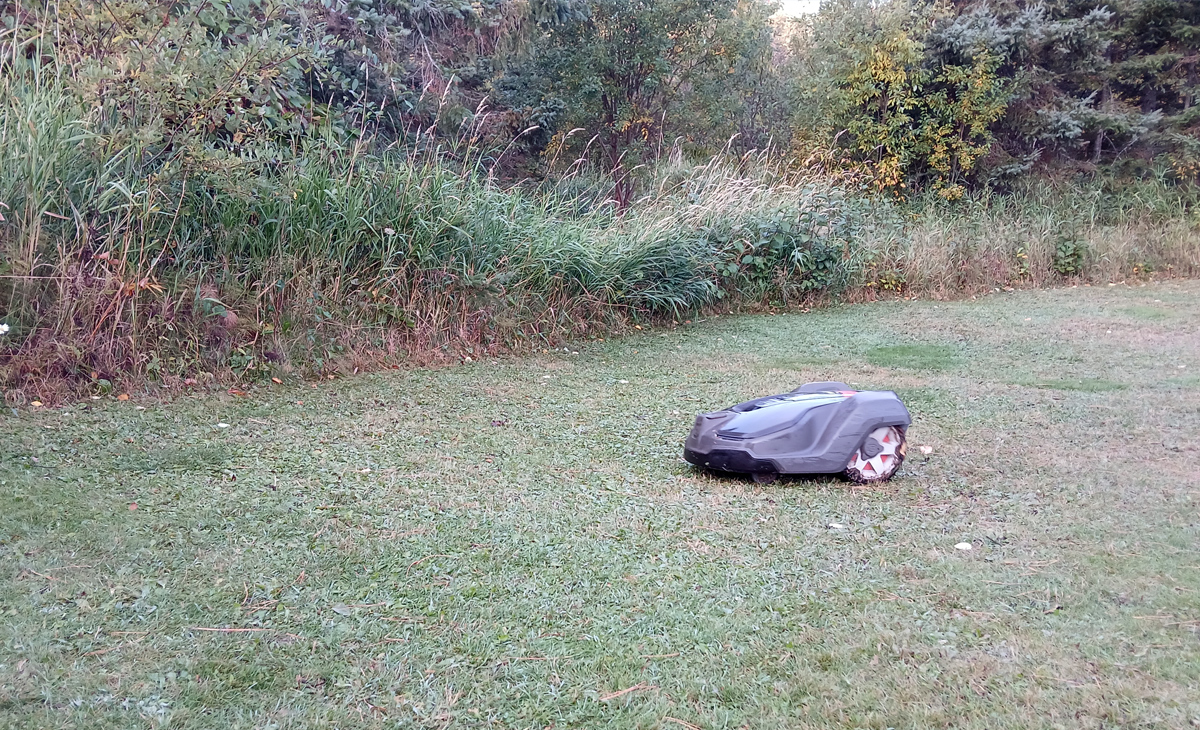
Drive past a Minnesota golf course early in the morning and you might spot a small machine quietly working the rough with nobody aboard. Robotic mowers have been common on European courses for years, and they’re now showing up here, both on golf courses and in home yards. Here’s how they work, what they cost and what to look for, whether you run a course or just want a better-looking lawn.
Prices current as of October 2026. Check with the seller before you buy.
How robotic mowers work
A robotic mower is a small, battery-powered mower that cuts on its own, a little at a time, and drives itself back to its charging station when it needs power. Because it mows often, it trims only a sliver of grass each pass, so there’s no bagging or raking: the clippings are tiny and fall back into the turf.
There are two ways a robot knows where to mow:
- Boundary wire. A thin wire is laid around the edge of the area, either pinned down or buried an inch or two. It’s reliable and less expensive, but installing it takes time and the wire can be cut by aerating or digging.
- GPS (RTK), no wire. Newer models use high-accuracy satellite positioning, often with cameras, to map the area. You draw the mowing zones in an app. There’s no wire to bury, and changing the layout takes minutes.
On the golf course
Courses mostly use robots on the rough, the driving range, practice areas and around clubhouses: large areas that take hours of a staff member’s time each week. Superintendents say the biggest benefit is labor: crews spend less time on routine mowing and more on greens, bunkers and course details. Robots are quiet and electric, so many courses run them overnight, and they’re out of the way before the first tee time.
What they can’t do yet: no robot currently mows greens, and robotic fairway mowers from the big turf companies are still in development. Most courses start with a few machines on one area, often the range, and add more once they see the results.
Husqvarna CEORA
Rough, fairways, ranges and sports fields
Husqvarna's large-area robot, built for golf. Each one covers about 5 to 6 acres a day, wire-free with GPS positioning, and courses usually run several as a fleet. Sold and installed through Husqvarna dealers.
- Price per mower (dealer quote)
- about $30,000–36,000
Kress MasterSeries RTKⁿ
Up to 20 acres per mower
Wire-free GPS mower that gets its positioning over a cellular connection, so no base station is needed on site. Handles slopes up to 40 percent. Available through dealers and some online robotics retailers.
- Kress KR238 (published price)
- $43,999
Husqvarna Automower 500 series
Surrounds, clubhouse grounds and smaller areas
Smaller commercial robots that courses use around clubhouses, parking areas and between holes. Wired and wire-free (EPOS) versions are available, installed by a dealer.
- Price, installed (dealer quote)
- about $6,000–8,000
Questions to ask a dealer
- How many machines would we need for the areas we want to mow, and how long would each area take?
- Is it wire-free, or will you need to lay boundary wire? Who installs it, and what does setup cost?
- What height of cut can it hold, and how does the cut compare with our reel and rotary mowers?
- How does it handle our slopes, wet areas, cart paths and golfers on the course?
- What do service, blades and batteries cost each year, and who services it in winter?
- Can we lease or finance it, and can we trial one before buying?
- Which courses near us already use them, and can we talk to their superintendent?
Dealers will often show you a cost comparison against your current mowers and labor. Those numbers can be very good for robots, but ask to see the assumptions behind them, especially labor hours and how many acres each machine really covers on your ground.
For your yard at home
Home robotic mowers have come down in price and gotten much smarter in the last few years. Most are sized by how much lawn they can handle, so start with your lot size (minus the house, driveway and gardens).
Husqvarna Automower
The long-time leader, wired and wire-free models
The brand most golf courses use, with home models from small city lots up to a couple of acres. Larger models are usually installed by a dealer.
- Automower 115H, up to about 0.4 acre
- $1,499
- Automower 430XH, up to about 0.8 acre
- $2,999
- Automower 450XH, up to about 1.25 acres
- $3,499
Segway Navimow
Wire-free, set up in an app
GPS models with no boundary wire, and a wide range of sizes. A popular choice for homeowners who want to install it themselves.
- i105N, about 0.3 acre
- $1,099
- X315, up to about 1.5 acres
- $2,999
- X350, up to about 2.5 acres
- $5,999
Mammotion LUBA 2 AWD
All-wheel drive for hills
Wire-free and all-wheel drive, so it climbs steep yards that stop most robots. A good fit for hilly lots and lake places.
- LUBA 2 AWD 3000, about 0.75 acre
- $2,999
- LUBA 2 AWD 5000, about 1.25 acres
- $3,499
- LUBA 2 AWD 10000, about 2.5 acres
- $5,499
Worx Landroid
Budget pick for smaller yards
Wired models at lower prices, best for small, simple, mostly flat lawns.
- Landroid M, about 0.25 acre
- $999
- Landroid L, about 0.5 acre
- $1,499
Tips for Minnesota yards
- Plan for winter. Bring the mower and its charging station inside before the snow flies, and charge the battery over the winter as the maker recommends. Many dealers offer winter storage and service.
- Measure your slopes. Check the mower’s maximum slope against your steepest spot, especially at the lake or on a walkout lot.
- Mow at night, carefully. Robots are quiet enough to run overnight, but set a schedule that keeps them off the lawn when kids and pets are outside, and watch for wildlife.
- Turn on the security features. Most have a PIN code, an alarm and GPS tracking if the mower is picked up or moved.
- Expect a short break-in. The first week or two the lawn evens out as the robot gets everything down to the same height. After that, it stays looking freshly cut.
Some links on this page may be affiliate links: if you buy through them, MNGolfCourses.com may earn a commission at no cost to you.